

Moving your business out of the spare bedroom and into a real office is a big step. It gives your team a place to work together, gives clients somewhere to meet you, and makes your business feel more established. But a first commercial lease is also one of the largest commitments a small business will make, so it pays to go in with your eyes open.
This guide walks you through ten things to sort out before you sign, from choosing the right part of Toronto to understanding what “additional rent” really means. We finish with how to plan your office relocation so you are up and running on day one.
1. Decide What Type of Workspace You Actually Need
Not every growing business needs a traditional private office right away. Before you start touring spaces, think about how your team really works day to day.
| Option | Works well for | Things to watch |
| Coworking desk | Solo founders and small teams who mostly work on laptops | Less privacy, shared meeting rooms, limited storage |
| Private office in a shared centre | Teams of two to ten who want a door that locks | Higher cost per person, less control over the layout |
| Leased office unit | Businesses ready to commit and build their own space | Longer lease terms, setup costs, furniture and moving costs |
If most of your work is done online and clients rarely visit, a flexible option may carry you for another year. If you store stock or equipment, need confidential meeting space, or are hiring steadily, a leased unit usually makes more sense.
2. Choose the Right Part of Toronto
Location affects your rent, your hiring and your daily routine. Downtown puts you close to clients and transit but usually costs more. Midtown, North York, Etobicoke and Scarborough can offer more space for your budget, while GTA cities like Mississauga and Markham suit businesses whose staff and customers live outside the core.
Ask yourself these questions for every location on your shortlist:
- How long will the daily commute be for your current team?
- Is the building close to a subway station or major bus route?
- Is there affordable parking for staff and visitors?
- Are banks, a post office, food and coffee within walking distance?
- Will the area help or hurt the image you want to give clients?
3. Work Out How Much Space You Need
It is easy to fall in love with a big, bright unit and then pay for empty desks for years. It is just as easy to squeeze into a tiny space and outgrow it within months. Plan for where your business will realistically be over the length of the lease.
Make a simple list of what the space must hold: desks for today’s team and planned hires, at least one meeting room, a small kitchen or break area, storage for files and supplies, and room for printers or other equipment. If any staff or visitors use mobility aids, check for step free access, wide doorways and accessible washrooms.
4. Budget for the Full Cost, Not Just Base Rent
In Toronto, office rent is usually quoted per square foot per year, and the headline number is rarely the full story. Many commercial leases add “additional rent” on top of base rent, often called TMI, which covers your share of property taxes, building maintenance and building insurance.
Build your budget around every cost you are likely to face:
- Base rent and additional rent (TMI).
- Utilities such as hydro, heating and cooling, especially after hours.
- Internet and phone setup and monthly plans.
- Parking for yourself, staff and visitors.
- Fit out costs like paint, flooring, walls, lighting and signage.
- Security deposit and any first and last month payments.
- Business insurance that your landlord will likely require.
- Furniture and equipment for the new space.
- Moving costs, including packing, movers and furniture assembly.
Budget tip: Ask the landlord or agent for last year’s additional rent figure per square foot. This helps you estimate your true monthly cost before you commit.
5. Inspect the Building, Not Just the Unit
The office itself may look perfect, but the building rules will shape your daily life and your moving day. Ask the property manager:
- Is there a freight elevator and a loading dock, and do they need to be booked?
- Are moves only allowed evenings or weekends?
- What paperwork do movers and contractors need to provide before they can work in the building?
- Which internet providers already service the building?
- Does heating and air conditioning run after business hours, and is there an extra charge?
- How do staff access the building after hours, and how are key cards issued?
The answers will also help your movers plan your relocation properly, so keep them in writing.
6. Understand Your Commercial Lease
In Ontario, commercial leases are covered by the Commercial Tenancies Act, not the Residential Tenancies Act that protects people renting homes. That means the lease you sign sets most of the rules, and far fewer protections apply automatically. Read every clause and consider having a lawyer who handles commercial leases review it before you sign.
Pay close attention to:
- Term and renewal. How long you are committed, and whether you have the option to renew.
- Rent increases. When and how the rent can go up during the term.
- Repairs and maintenance. What the landlord fixes and what you pay for.
- Assignment and subletting. Whether you can hand the space to someone else if your plans change.
- Personal guarantee. Many landlords ask small business owners to personally guarantee the rent. Understand what this means for your own finances.
- End of lease conditions. Whether you must remove your improvements and return the space to its original condition.
7. Start Your Search Early
Finding the right space, negotiating the lease, getting approvals and finishing any fit out work all take time. Rushing this process often leads to a poor deal or a space that does not really fit. Give yourself several months, and even more if the unit needs renovation before you can move in.
Tour a few spaces in different areas before you decide. Having more than one serious option also gives you more bargaining power.
8. Negotiate Before You Sign
Commercial rent is often more negotiable than first time tenants expect, especially for longer terms. Depending on the market and the landlord, you may be able to ask for:
- A rent free period at the start of the lease.
- A tenant improvement allowance to help pay for your fit out.
- A fixturing period to set up the space before rent begins.
- An option to expand into nearby space if you grow.
- A cap on how much additional rent can rise each year.
The worst the landlord can say is no, and every concession you win lowers the true cost of your space.
9. Plan Your Move In
Once the lease is signed, turn your attention to moving day. A smooth move in means your team can get straight back to work instead of spending days hunting for missing boxes.
- Book your movers as soon as you have the keys date and building move in rules.
- Arrange internet installation so it is live before your first work day.
- Draw a simple floor plan showing where each desk, cabinet and printer will go.
- Declutter before you pack, so you are not paying to move items you no longer need.
- Label every box with the person or area it belongs to.
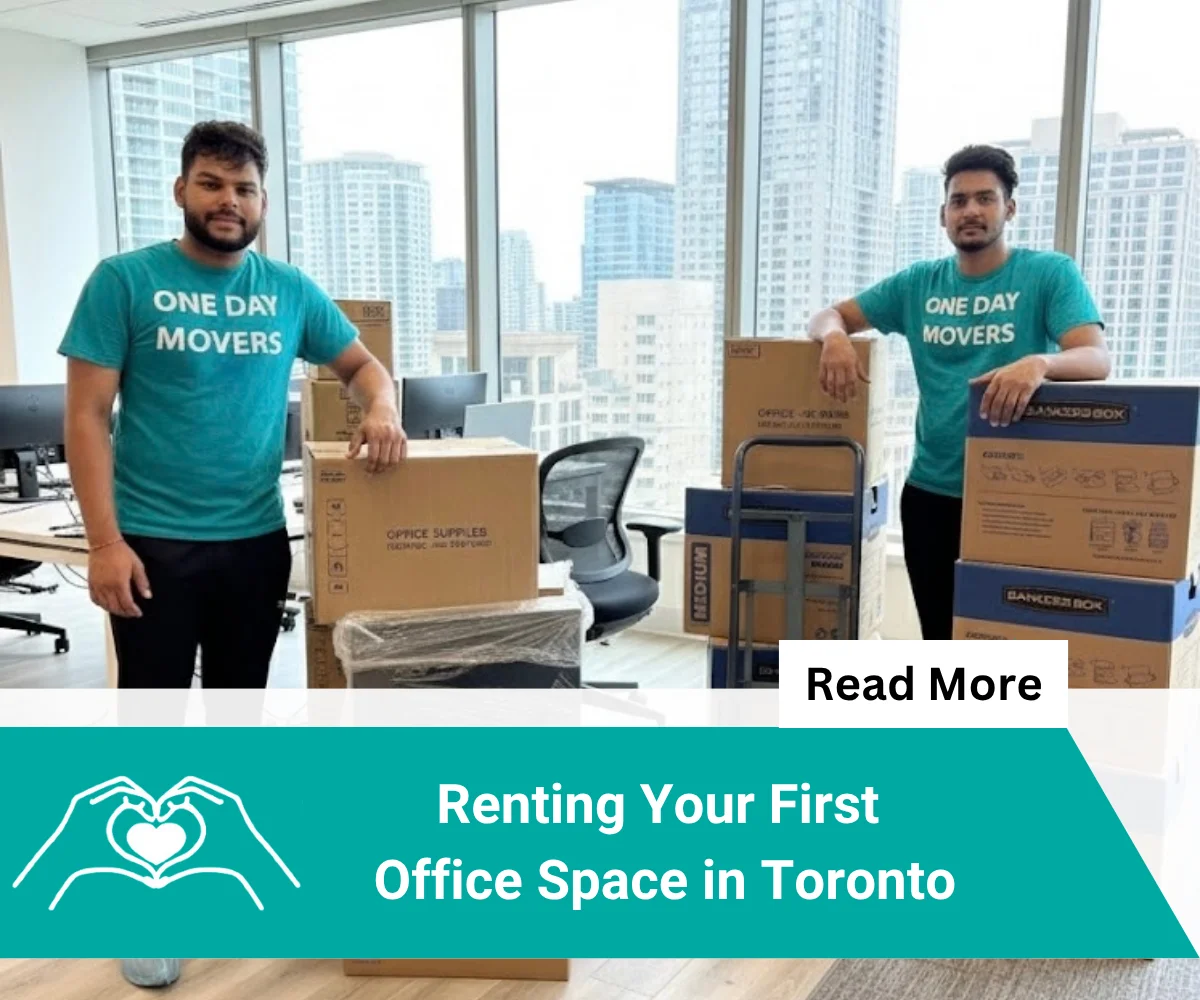
Professional office movers in Toronto can make this step much easier. At One Day Movers, our team starts with a pre move assessment so the relocation is planned before moving day. We handle everything from workstations to filing systems and printers, and our furniture assembly and disassembly service means your desks and shelving are rebuilt in the new space.
If you are moving a small office, our 18 ft truck is well suited to smaller office spaces. Need to hold some furniture while your fit out is finished? We also offer climate controlled storage for office items, short or long term. For extra help getting boxes ready, see our packing and unpacking services.
Our office moves use fixed, project based pricing, with no surprise fees for after hours or specialised handling. And because we offer moving services 24/7, 365 days a year, we can work around building rules that only allow evening or weekend moves.
10. Update Your Business Address Everywhere
A new office means a new address, and missing just one update can delay payments or confuse customers. Make a list and work through it in the weeks around your move:
- Canada Revenue Agency records for your business number.
- Ontario Business Registry, if your business is registered in Ontario.
- Your bank, payment providers and accountant.
- Google Business Profile, your website and social media pages.
- Invoices, email signatures, business cards and letterhead.
- Suppliers, couriers and key clients.
Frequently Asked Questions
Q. What is additional rent or TMI?
Additional rent is the amount a tenant pays on top of base rent to cover a share of the building’s property taxes, maintenance and insurance. It is common in Toronto commercial leases and can make a big difference to your monthly cost.
Q. Is a commercial lease the same as a residential lease?
No. In Ontario, commercial leases fall under the Commercial Tenancies Act, which gives tenants fewer automatic protections than residential renters have. This is why it is wise to have a lawyer review your lease.
Q. Should I hire professional movers for a small office?
Even a small office has heavy desks, filing cabinets and electronics that are easy to damage. Professional movers protect your equipment and your building, and they help you get back to work faster. Our guide on how to find the best office moving companies in Toronto explains what to look for.
Q. Can movers work evenings or weekends?
Many commercial buildings only allow moves outside business hours. One Day Movers works 24/7, 365 days a year, so we can schedule your move to suit your building and your team.
Q. How far ahead should I book office movers?
Book as soon as you know your move in date and building rules. Summer and month ends are the busiest times in Toronto, so earlier is better. Read our guide on how far in advance to book a moving company in Toronto.
Ready to Move Into Your First Office?
Your first office should help your business grow, not drain your budget. Take your time, understand every cost and every clause, and plan your move early. When you are ready for the move itself, One Day Movers is here to help across Toronto and the GTA. Read what other businesses say in our customer reviews, then get your free office moving quote.